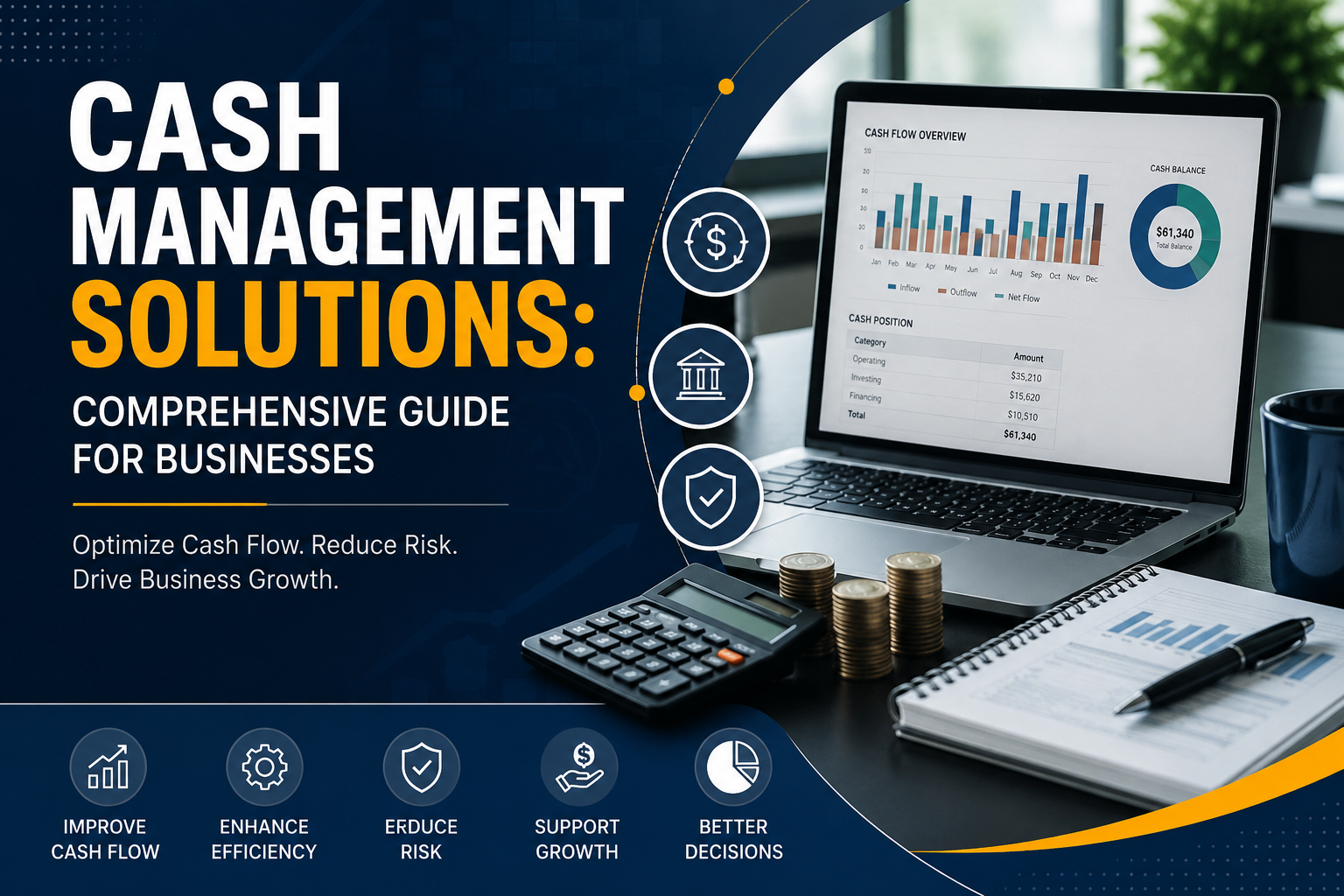
Cash management solutions are integrated systems and services that help businesses monitor, control, and optimise their cash flows. This includes automating collections and payments, improving real-time liquidity visibility, forecasting cash needs, and centralising financial workflows. By consolidating functions like accounts receivable, accounts payable, cash pooling and forecasting, these tools replace fragmented, manual processes with streamlined, efficient operations. All company sizes from SMBs to large enterprises benefit from better cash management. Effective solutions enhance profitability, reduce risk and free up capital for growth.
Streamlined cash management solutions consolidate payments, receivables and treasury workflows on one platform. Cash management solutions are integrated systems and services that give businesses real-time visibility into their cash and automate key financial workflows. In practice, a solution may combine business banking (payments, accounts), forecasting tools and AP/AR automation so finance teams see all inflows/outflows on one dashboard. For example, modern platforms “bring incoming and outgoing payments from different rails into the same spot”. They often includes cash pooling or in-house banking, automated payment processing, centralised invoicing / collections and analytical dashboards. In short, instead of juggling spreadsheets and disparate bank portals, companies get a unified cash management system.
Who Needs These Solutions? All businesses that deal with significant cash flows from startups to multinational corporations benefit from better cash management. SMBs especially feel cash pinch: “88% of small businesses report cash flow disruptions each year”. Retailers need quick POS reconciliation and payroll, manufacturers handle global supplier payments and schools or non-profits manage seasonal funding and tuition fees. In fact, BMO notes that retail, manufacturing and educational institutions all rely on cash management tools (e.g. POS systems, auto-payments, automated tuition processing) to smooth operations. Likewise, any organization with a finance team or treasury function CFOs, accountants or treasurers uses cash management solutions to stay on top of liquidity. Even governments and hospitals implement similar systems (often via treasury software).
Why Cash Management Matters: Effective cash management underpins financial health. Cash is the most critical but often least productive asset. Without its a profitable company can still fail (e.g. not paying to suppliers on time will lead towards trust issues). Good cash management ensures enough liquidity for obligations while allowing surplus funds to generate returns. This balance boosts profitability (“making smarter investments, avoiding idle cash”) improves decision-making (via real-time insights) and minimises risk (through early detection of cash shortages). In today’s uncertain economy, CFOs view cash management as a “touchstone of security”. It supports growth by keeping capital accessible and forewarns of impending shortfalls. Automation further magnifies these benefits by reducing errors and freeing staff for analysis. In short, a strong cash management strategy prevents crises and fuels growth through smarter use of cash.
Key Components & Features: A full cash management solution covers several areas:
- Liquidity Management: Real-time tracking of all bank balances (often across currencies and entities) to monitor how much cash is available. This includes cash positioning (daily snapshots) and cash pooling or in-house banking for group companies.
- Cash Forecasting: Analytical engines that predict future cash flows based on actual data. Good systems update forecasts automatically as payments and receipts clear / improving accuracy.
- Automated Payments (AP) & Collections (AR): Workflow tools to schedule and approve vendor payments (e.g. ACH or card payments) and to send invoices and reminders. Automation accelerates cash inflow by “making sure you get paid faster” and reduces late-pay fees.
- Reporting & Analytics: Dashboards showing cash runway, funding needs and performance against budget. Integration with ERP/accounting systems ensures financial data (revenue, expenses) flows into the cash view.
- Integration & Connectivity: APIs or bank integrations (SWIFT, EBICS) link the system to multiple accounts and ledgers. This unifies data and eliminates manual reconciliation.
Additional features often include multi-entity consolidations, mobile access, user permission controls and (for investment-focused tools) automatic transfers into short term investments. In summary, the solution should centralise accounts payable, receivable, treasury and banking in one platform.
Solution Options: Cash management solutions come in three broad categories: traditional bank platforms, standalone fintech systems, and large-scale treasury/ERP software. Each has pros and cons:
- Bank Cash Management Services: Major banks (e.g. HSBC, Citibank, Standard Chartered) offer business cash management suites (via online portals or software). They handle global payments, receivables (lockbox/EDI) and account management.
- Advantages: High security/compliance, seamless integration with accounts.
- Drawbacks: Often rigid interfaces and higher fees. Many banks bundle basic services for free up to a threshold (e.g. unlimited digital transfers) and charge for extras (e.g. same-day ACH or international wires). Banks are ideal for large corporates needing global reach, though some banks now provide scaled solutions for SMEs.
- Fintech/Cash-Platform Providers: Newer entrants (e.g. Rho, Brex, Revolut Business, Trovata, Agicap) offer cloud based cash management that is highly automated and user-friendly. They connect to multiple banks, provide real-time dashboards, cards for spending and often high-yield treasury accounts. Fintech platforms excel in modern UX, rapid deployment and features like AI-powered forecasting. For example, Rho’s financial operating system is free to use (charging only 0.6% per year on invested cash). Another example, Trovata, uses AI to automate cash reporting. Fintechs typically target fast-growing companies and mid-market firms that want flexibility.
Treasury/ERP Software: Enterprise software (SAP S/4HANA, Oracle Fusion, Kyriba, Coupa) includes comprehensive cash/treasury modules. These are deep systems suited for large multi-entity corporations. They integrate tightly with ERP or accounting systems and support complex treasury functions (FX, hedging, risk compliance). Top providers like Kyriba offer “predictive analytics and scenario modelling” for global finance teams. However, they are expensive and require lengthy implementation.
| Solution Category | Examples | Typical Users | Key Pros/Cons |
|---|---|---|---|
| Bank Platforms | HSBC CashPro, BofA Cash Management | Large corporates SMEs via online banks | Integrated with banking, Regulatory trust, Less flexible UI Fee structures |
| Fintech Platforms | Rho, Pleo, Brex, Agicap, Trovata | SMEs & mid market companies | Easy UX, Automation/AI features, Rapid onboarding, May lack some legacy integrations, Relies on external connectivity |
| Treasury Software | Kyriba, SAP S/4HANA, Oracle | Large multinationals, corporates | Full-featured (multi-currency, FX, pooling), High scalability, High cost & complexity, Longer deployment time. |
By comparing these businesses can choose a solution that matches their size and complexity. For example, a growing tech startup might opt for Rho or Brex for ease of use and a free platform, whereas a global manufacturer might invest in SAP or Kyriba for deep treasury controls.
Implementation Steps
Deploying a cash management solution generally follows these steps:
- Assess Needs & Objectives: Map existing cash flows and pain points. Determines required features (e.g. multi-currency support, integration needs).
- Vendor Selection: Research providers and request demos. Compare pricing and features against requirements. Solicit references and case studies.
- Data & System Integration: Connect the solution to bank accounts and accounting / ERP systems via APIs or secure feeds. Set up account hierarchies and user access.
- Configuration & Testing: Configure workflows (e.g. approval rules, payment schedules). Migrate initial data (balances, customer/vendor lists). Thoroughly test with sample transactions to ensure accuracy.
- Training & Change Management: Educate finance staff on the new platform. Provide documentation and support for day-to-day tasks (making payments, generating reports).
- Go-Live & Monitoring: Launch the system for live use. Closely monitor early transactions for any issues. Adjust processes as needed.
- Ongoing Optimization: Review performance and user feedback. Fine-tune cash forecasts, credit terms or investment allocations. Regularly update system integrations.
While generic, these steps ensure a smooth roll-out. Larger organizations may use formal project teams and change-management plans, whereas, smaller firms can often pilot features quickly. Throughout, strong internal controls (dual authorizations, audit trails) should be built in to protect cash and maintain compliance.
Costs & Pricing Models
Pricing varies widely depending on solution type. Banks often include basic cash management tools free with business accounts, charging fees for premium services (e.g. expedited payments, positive pay). Fintech platforms usually charge subscription fees or tiered plans (some are free up to a limit). For instance, Rho’s core platform has no monthly fee, only its investment service carries a management fee capped at 0.60% tentatively. Other fintechs (e.g. Agicap) may price per account or per user.
Enterprise treasury software typically uses license or subscription + implementation fees. Pricing may be a fixed annual license or usage based (per company entity or transaction volume). Many large vendors require custom quotes (contact sales for pricing). Key models include:
- Per-Account/Transaction: Useful for banks or processors, charging per ACH or wire.
- Subscription: Flat monthly / annual fee for software access (common in fintech/SaaS).
- License + Maintenance: Large upfront license plus annual support (traditional TMS).
- Percentage of Funds Managed: Applied to invested cash (as with Rho) or assets under management.
Businesses should also consider hidden costs like bank account fees, multi-currency fees, training time or additional modules (e.g. FX or lending). In general, fintech solutions offer transparent SaaS pricing, whereas, banks / TMS may have complex fee schedules. Align the model with your budget and cash volume, high-volume firms might benefit from subscription models that cap costs while low-volume businesses may prefer pay per use.
Security & Compliance
Because cash management touches all company funds, security is paramount. Reputable solutions implement multi-factor authentication, encryption of data at rest, in transit and role-based access controls. For example, bank portals and TMS platforms undergo regular security audits and comply with standards like ISO 27001 and SOC 2. If payment cards or online payments are involved, PCI DSS compliance is required for handling cardholder data. Many solutions also integrate fraud detection (flagging unusual transactions) and automatically enforce policies (e.g. payment limits).
Regulatory compliance: Businesses must adhere to anti-money laundering (AML) and KYC regulations so cash management systems often include KYC workflows for customers and suppliers. In banking, treasury activities must meet central bank and financial regulator rules (e.g. foreign exchange reporting, reserve requirements). For multi-national companies, data residency and cross-border payments regulations (like GDPR or local payment laws) are considerations. Ensuring the solution’s vendor follows these regulations and provides audit logs is critical.
Internal controls: Finance departments should implement controls around cash management, dual approvals for large payments, segregation of duties between cash creators (sales invoicing) and cash disbursers (payments). Good systems log every user action (who approved, who executed) to aid audits. In sum, a solid cash management solution will support compliance and actively reduce risk from fraud or error.
KPIs to Track
Key Performance Indicators (KPIs) turn cash management efforts into measurable results. Common KPIs include:
- Cash Visibility %: The share of total cash easily viewable / accessible in real time. Higher visibility means stronger liquidity control.
- Forecast Accuracy: Variance between actual cash flow and forecasts (overall or by business unit). Tracking forecast error (e.g. as a %) helps refine models.
- Days Sales Outstanding (DSO): Average collection period for receivables. Lower DSO improves liquidity.
- Days Payable Outstanding (DPO): Average payment period to suppliers. Optimizing DPO (without hurting terms) can boost cash on hand.
- Cash Conversion Cycle: (DSO + Inventory Days DPO) gauges how quickly a company turns resources into cash. A shorter cycle is better.
- Payment Success Rate: Percentage of payments processed correctly on first attempt. A high rate means efficient operations (reducing rework and late fees).
- Idle Cash Ratio: % of cash in non-interest-bearing accounts vs total cash. Lower ratios indicate more cash earning interest.
- Return on Cash: Yield earned on invested cash (e.g. Treasury bills, money markets). This shows how effectively surplus cash is used.
By monitoring these KPIs over time, companies can spot issues (e.g. rising forecast errors or creeping cycle times) and adjust strategies. Leading finance teams often build dashboards with these metrics, linking them back to cash management processes and decisions.
FAQs
Q: What is a cash management solution?
A: It’s an integrated system of tools (banking, accounting and treasury software) that helps a business track and optimize its inflows and outflows. It provides real time insight into account balances, automates payments, collections and supports forecasting.
Q: Why do I need one?
A: Even profitable companies can fail from poor cash management. These solutions ensure you have enough liquidity to pay bills on time, while making intelligent use of excess cash. They improve efficiency (fewer late payments and errors), aid decision-making with analytics and free up working capital.
Q: What features should I look for?
A: Essentials include real time cash positioning, automated AP/AR workflows, robust forecasting and secure bank integration. Search for features like multi-entity support, multi-currency handling and API connectivity.
Q: How much does a cash management solution cost?
A: Costs vary. Many providers use subscription pricing or tiered plans. Some fintechs are free up to certain limits (as with Rho’s free platform). Bank services may be included with accounts or incur per transaction fees. Large enterprise software often requires a custom quote. Always compare pricing models against your transaction volume and feature needs.
Q: How do I implement a cash management solution?
A: Start by auditing your current cash flows and pain points. Then select a solution that fits your size/needs. Plan the rollout: connect bank and accounting systems, migrate data, train staff, and test thoroughly. Monitor KPIs after go-live to ensure the system is working as intended (see “Implementation Steps” above).